ACL Tears in Football: Evidence-Based Sports Therapy Rehabilitation and Return-to-Play Strategies
Anterior cruciate ligament (ACL) injuries are among the most severe and common injuries in football due to the sport’s high physical demands, including rapid acceleration, deceleration, cutting, pivoting, and jumping. The ACL is a key stabilizing ligament in the knee that prevents anterior translation and rotational instability of the tibia relative to the femur. When ruptured, it can significantly impair an athlete’s performance and long-term knee function.
Many elite footballers have suffered ACL injuries during their careers, including Virgil van Dijk and Zlatan Ibrahimović, highlighting the prevalence of this injury even at the highest levels of sport.
Rehabilitation following ACL injury or reconstruction is a complex and multifactorial process. Modern sports therapy emphasizes evidence-based, sport-specific rehabilitation strategies designed not only to restore knee function but also to prepare athletes for the physical and psychological demands of competitive football.
Mechanism of ACL Injury in Football
ACL injuries in football typically occur through non-contact mechanisms, such as sudden changes in direction, pivoting, or awkward landing after a jump. These movements generate high rotational forces within the knee joint.
Key risk factors include:
⦁ Poor neuromuscular control
⦁ Fatigue and reduced muscle coordination
⦁ Imbalances between quadriceps and hamstring strength
⦁ Poor landing mechanics
Biomechanical analyses show that abnormal knee valgus and trunk positioning during landing can significantly increase ACL injury risk (Silvers-Granelli et al.). Neuromuscular warm-up programs targeting these movement patterns have been shown to reduce injury rates by over 46% in collegiate soccer players.
Traditional Rehabilitation vs Sports Therapy Rehabilitation
Traditional Physiotherapy
Conventional physiotherapy after ACL reconstruction often focuses on:
⦁ Pain management
⦁ Range of motion restoration
⦁ Basic muscle strengthening
⦁ Return to daily activities
While effective for restoring basic function, this approach may not adequately prepare athletes for the high mechanical demands of football.
Sports Therapy Approach
Sports therapy rehabilitation expands beyond basic recovery and incorporates:
⦁ Neuromuscular control training
⦁ Sport-specific movement patterns
⦁ Biomechanical movement analysis
⦁ Psychological readiness assessment
⦁ Functional return-to-sport testing
Research highlights that ACL rehabilitation should be viewed as a multidimensional process that includes physical, psychological, and contextual factors affecting the athlete’s return to sport.
The goal is not simply recovery, but safe return to performance.
Evidence-Based Phases of ACL Rehabilitation
Phase 1: Acute Protection and Inflammation Control (0–2 weeks)
Goals
⦁ Reduce swelling and inflammation
⦁ Restore full knee extension
⦁ Activate quadriceps muscles
⦁ Protect the surgical graft (if reconstruction is performed)
Sports Therapy Interventions
⦁ Cryotherapy and compression
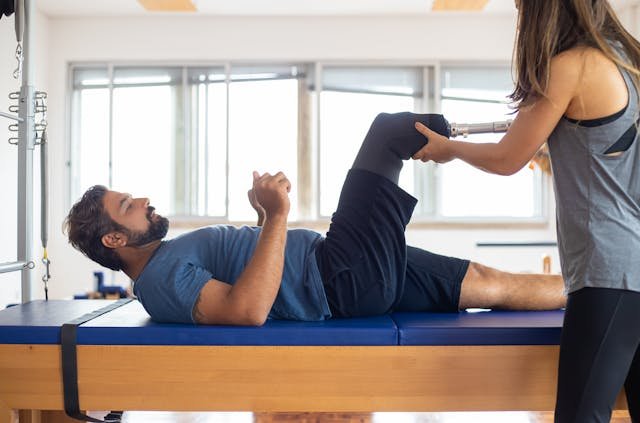
⦁ Passive and active range-of-motion exercises
⦁ Quadriceps activation exercises (quad sets, straight leg raises)
⦁ Partial weight bearing with crutches
Early rehabilitation is crucial. Studies show that early initiation of physiotherapy significantly improves knee range of motion, strength, and proprioception following ACL reconstruction.
Phase 2: Strength and Neuromuscular Control (2–8 weeks)
Goals
⦁ Restore normal gait mechanics
⦁ Improve knee flexion and extension range
⦁ Begin strengthening surrounding musculature
⦁ Enhance proprioception
Key Exercises
⦁ Closed chain strengthening exercises (squats, step-ups)
⦁ Balance training and single-leg stability drills
⦁ Stationary cycling
⦁ Core and hip strengthening
Proprioceptive training is essential because ACL injuries disrupt joint mechanoreceptors, affecting neuromuscular coordination.
Phase 3: Strength Development and Movement Re-Education (8–16 weeks)
Goals
⦁ Improve muscular strength and endurance
⦁ Correct faulty movement patterns
⦁ Introduce controlled functional movements
Sports Therapy Techniques
⦁ Resistance training for quadriceps and hamstrings
⦁ Lunges and progressive squats
⦁ Core stabilization programs
⦁ Controlled plyometric exercises
Electromyography research has shown that hamstring activation deficits can persist months after ACL reconstruction, highlighting the need for targeted neuromuscular training during rehabilitation.
Phase 4: Sport-Specific Rehabilitation (4–6 months)
This phase distinguishes sports therapy from general rehabilitation.
Objectives
⦁ Reintroduce football-specific movements
⦁ Improve agility, acceleration, and deceleration
⦁ Develop power and reactive strength
Training Components
⦁ Plyometric drills
⦁ Change-of-direction drills
⦁ Sprint training
⦁ Controlled football skills (passing, dribbling)
Sport-specific rehabilitation replicates the movement demands of football such as sprinting, jumping, and cutting to prepare athletes for competitive play.
Phase 5: Return-to-Sport (6–9+ months)
Returning to football should be criteria-based rather than time-based.
Athletes must demonstrate:
⦁ ≥90% limb symmetry index in strength tests
⦁ Successful completion of hop and agility tests
⦁ Adequate neuromuscular control
⦁ Psychological readiness Return-to-sport testing commonly includes:
⦁ Single leg hop tests

⦁ Triple hop tests
⦁ T-test agility assessment
⦁ Isokinetic strength testing

Psychological Rehabilitation
Psychological factors play a major role in successful recovery.
Common psychological barriers include:
⦁ Fear of reinjury
⦁ Lack of confidence in the knee
⦁ Anxiety about returning to competition
Evidence indicates that psychological readiness strongly influences movement patterns and reinjury risk, even when physical recovery appears complete.
Sports therapists often incorporate:
⦁ graded exposure to sport situations
⦁ confidence-building exercises
⦁ collaboration with sports psychologists

Reinjury Prevention
ACL reinjury remains a major concern in football.
Preventive strategies include:
⦁ Neuromuscular warm-up programs
⦁ Strengthening hamstrings and gluteal muscles
⦁ Improving landing mechanics
⦁ Monitoring training load
Neuromuscular training programs have demonstrated substantial reductions in injury risk and improved biomechanical control during sport-specific movements.
Effectiveness of Sports Therapy Rehabilitation
Sports therapy rehabilitation offers several advantages over conventional treatment:
Sports therapy rehabilitation offers several advantages over conventional treatment:
- Sport-Specific Conditioning
Training mimics football movements, preparing athletes for real match situations. - Improved Neuromuscular Control
Proprioception and coordination training restore dynamic knee stability. - Evidence-Based Return-to-Sport Testing
Objective criteria reduce the risk of premature return to play. - Holistic Athlete Management
Programs address both physical and psychological recovery, improving long-term outcomes.
Conclusion
ACL injuries represent a significant challenge for footballers due to the complex biomechanical demands of the sport. Modern sports therapy rehabilitation emphasizes a multidisciplinary, evidence-based approach that integrates strength training, neuromuscular control, psychological readiness, and sport-specific conditioning.
By focusing on performance restoration rather than basic recovery, sports therapists play a critical role in reducing reinjury risk and enabling athletes to safely return to competitive football.
References
Ardern CL et al. (2014). Return to sport following ACL reconstruction surgery. British Journal of Sports Medicine.
Silvers-Granelli H et al. (2015). Neuromuscular training reduces ACL injuries in soccer players.
Fältström A et al. (2024). Athletes’ perspectives on return to sport after ACL reconstruction. BMC Sports Science, Medicine and Rehabilitation.
Journal of Orthopaedic Surgery and Research (2025). Early vs delayed physical therapy after ACL reconstruction.
Walker A et al. (2024). Physiotherapist-led rehabilitation program after ACL reconstruction.
Neurocognitive and Neuromuscular Rehabilitation after ACL injury.
Sports physiotherapy perspectives on ACL management.
Author:
Ahmed Juraije
Sports Therapist | Rehabilitation Specialist | Performance Recovery Consultant
Qualifications
⦁ Doctor of Physical Therapy (DPT)
⦁ Master of Science in Sports and Exercise Therapy UK
⦁ Certified Acupuncturist
⦁ Member of the The Society of Sports Therapists UK
Professional Profile
Ahmed Juraije is a sports Therapist and rehabilitation specialist with expertise in the assessment, treatment, and performance rehabilitation of musculoskeletal injuries in athletes. His clinical practice focuses on evidence-based rehabilitation, neuromuscular training, and sport-specific conditioning to support safe and effective return-to-play outcomes.
Ahmed has experience working with knee injuries such as ACL tears, integrating modern sports therapy techniques, strength and conditioning principles, and recovery strategies to optimize athlete performance and reduce reinjury risk. His approach combines manual therapy, therapeutic exercise, acupuncture, and advanced rehabilitation protocols tailored to the specific demands of football and other high-intensity sports.